 Alious
🚨 PREMIER LEAGUE ISSUES OFFICIAL EXPLANATION AFTER BRENNAN JOHNSON’S DISALLOWED GOAL! EVERTON FUMING AS REFEREE MICHAEL SALISBURY’S DECISION SPARKS HUGE VAR DEBATE! 😡🔥
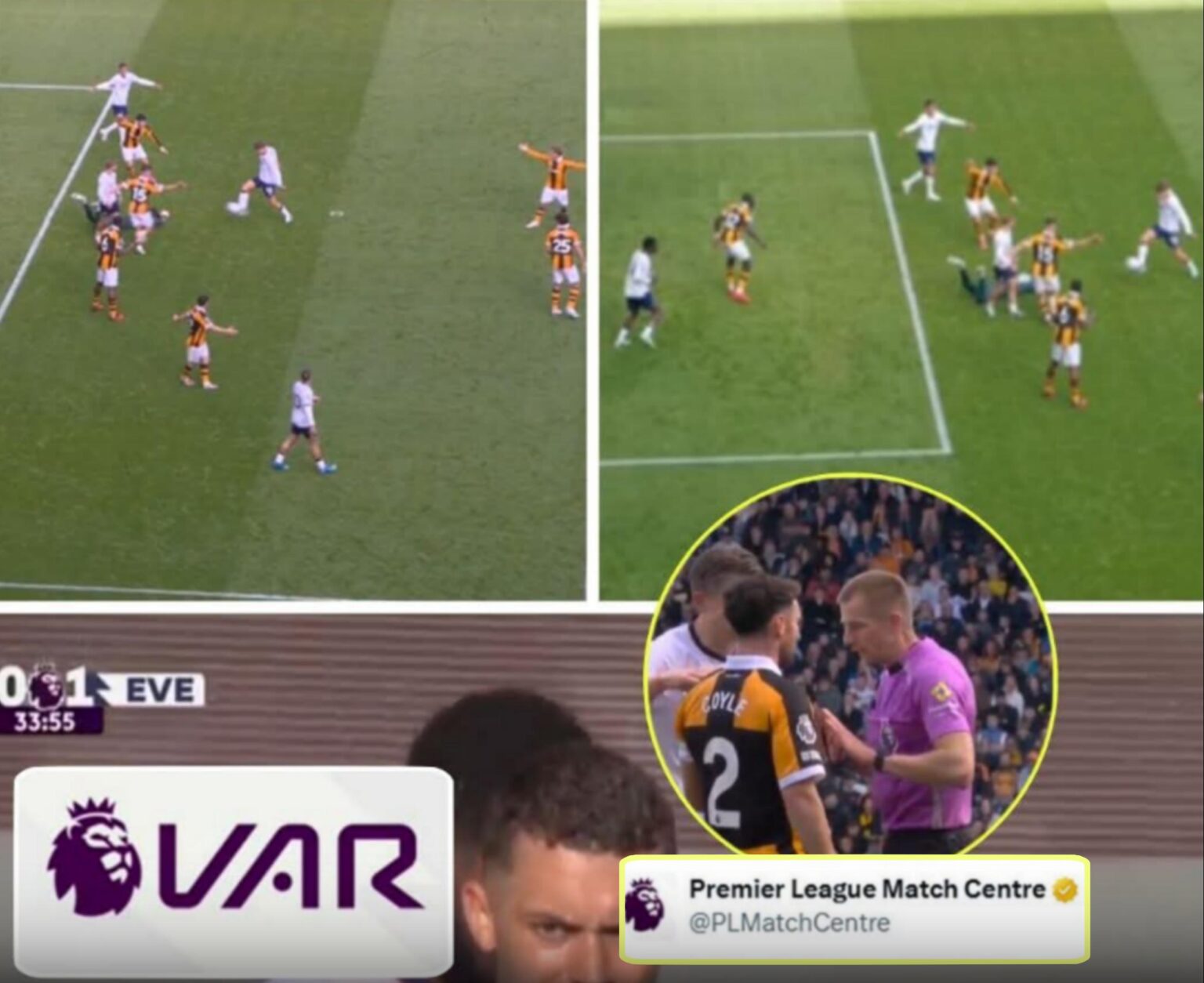
The controversy surrounding Brennan Johnson’s disallowed goal for Everton against Hull City has ignited another fierce debate about Premier League officiating, with referee Michael Salisbury facing criticism following a contentious decision at the MKM Stadium.
Everton thought they had broken the deadlock when Johnson found the net in the 34th minute, but their celebrations were abruptly interrupted after an offside infringement was identified. The incident prompted a VAR review, with Salisbury reportedly consulting the pitchside monitor before ultimately ruling out the goal.
The decision left Everton’s players frustrated and manager David Moyes questioning the interpretation of the offside law. What appeared to be a successful attacking move for the visitors instead became one of the most discussed moments of the match.
According to the explanation attributed to the Premier League Match Centre in the supplied report, the decision was reviewed and upheld by VAR. The officials reportedly concluded that Johnson was in an offside position and had interfered with an opponent by challenging for the ball.
However, the explanation has not ended the debate. Questions remain about what constitutes interference, particularly when an attacking player does not make contact with the ball but is considered to have affected an opponent’s ability to play it.
😳 EVERTON CELEBRATIONS CUT SHORT AS JOHNSON’S GOAL IS RULED OUT
Everton supporters travelling to Hull had reason to celebrate in the 34th minute when Johnson appeared to give their team the breakthrough.
The forward finished the move and seemingly put the visitors in front, raising hopes that Everton could take control of the contest.
But the celebrations did not last long.
The assistant referee signalled an offside offence, prompting the officials to examine the incident more closely. Salisbury subsequently reviewed the situation at the pitchside monitor before deciding that the goal could not stand.
For Everton, it was an enormously frustrating development. Their players believed they had completed the attacking move successfully, only to see the reward taken away following the officials’ intervention.
Hull City, meanwhile, were handed a significant reprieve. The home side avoided falling behind and were able to continue competing in a match that remained finely balanced.
The incident immediately became a major talking point because the decision hinged on Johnson’s involvement in the play rather than simply on whether he touched the ball.
That distinction is central to understanding the controversy.
🚨 PREMIER LEAGUE EXPLAINS WHY THE GOAL WAS DISALLOWED
The report attributes the following explanation to the Premier League Match Centre:
“Brennan Johnson was in an offside position and deemed to be challenging an opponent for the ball. The referee’s decision to disallow the goal was checked and confirmed by VAR.”
The explanation suggests that the officials believed Johnson had become actively involved in the attacking move while occupying an offside position.
Under the Laws of the Game, being in an offside position does not automatically constitute an offence. A player must become involved in active play in a manner covered by the rules, including interfering with an opponent.
Such interference can occur when a player challenges an opponent for the ball or affects an opponent’s ability to play it.
Consequently, an attacking player does not necessarily have to touch the ball before an offside offence can be called.
In Johnson’s case, the officials reportedly determined that his actions crossed that threshold.
The explanation, however, has done little to prevent disagreement among supporters. Some may focus on whether Johnson actually touched the ball, while others will consider whether his positioning and movement affected a Hull defender or another opponent involved in the play.
The important distinction is that the absence of contact does not automatically mean the attacking player cannot be penalised.
Nevertheless, the precise circumstances of the incident remain crucial when assessing whether the decision was justified.
😡 DAVID MOYES VOICES HIS FRUSTRATION OVER THE OFFICIATING
Everton manager David Moyes was reportedly unhappy with the decision and expressed frustration over the terminology used to explain the incident.
The experienced manager questioned the description of the incident as a subjective offside decision, suggesting that the language surrounding the call was unfamiliar to him.
Moyes was quoted as saying:
“I don’t know what subjective offside is, and I don’t think any of you do either. I’ve been in football a long time. I’ve never heard of that term before tonight.”
His reported comments reflected Everton’s dissatisfaction with the way the incident was handled.
The manager also expressed his frustration at seeing a goal ruled out when his team believed it had scored legitimately.
“We scored a goal that looked perfectly fine. The boys are frustrated. I’m frustrated. It’s a decision that has cost us.”
For Moyes, the disappointment was understandable from a competitive perspective. Goals can change the momentum of a match, particularly when a team is attempting to establish control over a difficult away fixture.
Having a potential opener overturned meant Everton had to continue searching for another breakthrough.
The involvement of VAR also added another layer to the controversy. While video technology is intended to help officials reach the correct decisions, reviews involving subjective interpretations can leave players, managers and supporters searching for clearer explanations.
However, frustration from the Everton camp does not independently establish whether the call was right or wrong. The central issue remains whether Johnson’s involvement met the requirements for an offside offence under the Laws of the Game.
⚖️ FOOTBALL EXPERTS REPORTEDLY DIVIDED OVER THE CONTROVERSY
The incident has also generated differing reactions from football analysts and former officials, according to the supplied report.
Former Premier League assistant referee Darren Cann reportedly supported Salisbury’s intervention, describing it as an excellent and correct decision.
Sky Sports pundit Don Goodman was also reported to have agreed with the officials’ conclusion.
“In my opinion, the goal was correctly ruled out.”
However, Pat Nevin reportedly expressed confusion while discussing the incident on BBC Radio 5 Live, raising questions about the amount of time taken to reach a final decision.
These contrasting reactions demonstrate why offside incidents involving interference can be particularly difficult to assess.
When a player is clearly beyond the defensive line and touches the ball, the explanation for an offside decision may be relatively straightforward.
The situation becomes more complicated when the player does not touch the ball but is considered to have influenced an opponent’s actions.
Officials must assess the player’s position, movements and involvement in the passage of play. They must then determine whether that involvement satisfies the conditions for an offside offence.
Such assessments can produce disagreement, even among people with extensive experience of the game.
For supporters, the challenge is understanding precisely what the officials believe happened and how the relevant law applies to the incident.
A clear explanation is therefore essential whenever a contentious decision becomes the centre of attention.
🔥 HOW THE CONTROVERSIAL CALL AFFECTED EVERTON AND HULL CITY
Johnson’s disallowed effort became one of the defining talking points of the encounter.
For Everton, the goal could have provided an important advantage and changed the way the remainder of the contest unfolded.
Instead, the visitors were forced to continue looking for a way through Hull City’s defence.
For the home side, the decision offered a welcome escape from a potentially damaging situation. Remaining level allowed Hull to stay in the contest and continue pursuing a positive result.
According to the supplied match report, Everton eventually found another route to goal, while Hull responded through Joe Gelhardt, who reportedly lifted the ball over goalkeeper Jordan Pickford.
The match finished 1-1, leaving both teams with a point.
Hull could take encouragement from their ability to remain competitive against Everton, while Moyes and his players were left to reflect on the disallowed goal and the questions it raised about the officials’ interpretation of the rules.
It is impossible to establish precisely how the match would have developed had Johnson’s effort been allowed to stand. An early goal can influence tactics, confidence and the balance of a contest, but the eventual outcome would still have depended on everything that followed.
Nevertheless, the incident became a significant talking point because of its potential importance and the debate surrounding the reasoning behind it.
🧐 WHAT DOES ‘SUBJECTIVE OFFSIDE’ ACTUALLY MEAN?
The controversy highlights one of football’s most frequently misunderstood aspects of the offside law: the difference between occupying an offside position and committing an offside offence.
A player can be standing in an offside position without automatically breaking the rules.
An offence occurs when that player becomes involved in active play in one of the ways defined by the Laws of the Game.
One of those situations involves interfering with an opponent.
For example, a player who is in an offside position might challenge an opponent for the ball or obstruct an opponent’s ability to play it. Depending on the circumstances, the officials may consider that involvement sufficient to penalise the attacking team.
This means that touching the ball is not the only factor that matters.
The referee must consider whether the player’s actions affected an opponent in a way recognised by the offside law.
Such decisions involve interpretation rather than a purely mechanical measurement of a player’s position. That is why they can attract more debate than straightforward offside calls.
In Johnson’s case, the explanation attributed to the Premier League Match Centre focused on his position and the assessment that he was challenging an opponent for the ball.
The disagreement centres on whether that interpretation accurately reflected what happened during the attacking move.
For Everton supporters, a detailed explanation of the relevant actions could help clarify why the goal was disallowed. For neutral observers, the incident provides another example of the challenges involved in applying the offside law consistently.
Ultimately, understanding the distinction between being offside and committing an offside offence is essential to evaluating the decision.
🚨 THE FINAL VERDICT: VAR EXPLANATION FAILS TO END THE DEBATE
The controversy surrounding Brennan Johnson’s disallowed goal has placed Michael Salisbury’s decision under the spotlight and renewed discussion about how officials interpret interference during attacking moves.
The explanation attributed to the Premier League Match Centre states that Johnson was in an offside position and was judged to be challenging an opponent for the ball. The report also says that VAR checked and confirmed the referee’s decision.
Moyes’ reported reaction highlights Everton’s frustration, while the differing opinions attributed to football figures demonstrate that the incident has attracted debate beyond the two teams involved.
Hull City and Everton ultimately shared the points in a 1-1 draw, but Johnson’s disallowed goal remained one of the match’s most contentious moments.
The key question is not simply whether Johnson touched the ball. It is whether his positioning and involvement interfered with an opponent in a manner that constituted an offside offence.
That distinction lies at the heart of the controversy.
What is your verdict? 🤔
Was Michael Salisbury right to disallow Brennan Johnson’s goal, or do you believe Everton should have been allowed to take the lead?
Drop your opinion in the comments below! 🐯⚽🔥

 Alious