 Alious
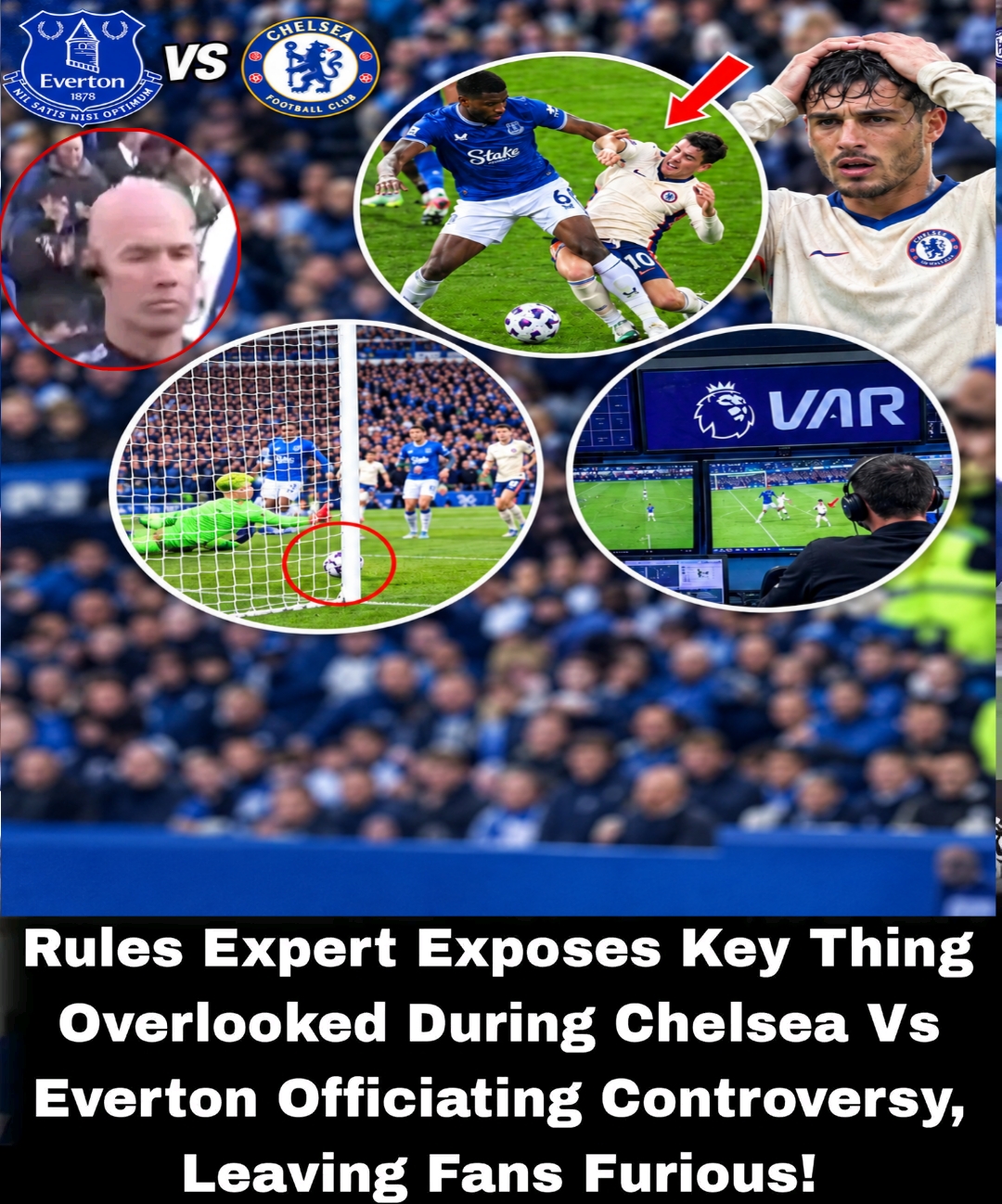
The controversy surrounding Chelsea’s 2–0 victory over Everton continues to attract attention, with the spotlight moving away from the final score and towards the officiating decisions that became a major talking point during the encounter.
Although Chelsea secured all three points, questions have emerged among supporters about how certain incidents were handled by the match officials. The confrontation involving Chelsea’s Morgan Rogers and Everton defender James Tarkowski has attracted particular attention, with fans examining the sequence of events and the disciplinary decisions that followed.
Now, claims that a rules expert has highlighted a potentially important detail have added another dimension to the debate.
For Everton supporters, the issue is not simply about accepting defeat. Many want to understand whether the relevant laws were applied consistently, whether the officials considered all the circumstances surrounding the disputed incidents, and whether both teams were treated equally.
However, determining whether a genuine refereeing error occurred requires a careful examination of the footage, the applicable rules and the decisions made during the match.
🔥 A VICTORY OVERSHADOWED BY REFEREEING QUESTIONS
Chelsea’s 2–0 triumph over Everton should ordinarily have been remembered for the result and the performances that secured the victory.
Instead, the conversation has increasingly centred on controversial moments that left sections of the football community questioning the officials’ judgement.
In a competition as fiercely contested as the Premier League, even a single refereeing decision can become a major talking point. A challenge, a disputed foul, a possible booking or a decision to allow play to continue can influence the momentum of a match.
Consequently, supporters often scrutinise incidents involving their clubs, particularly when they believe an important decision has gone against their team.
Everton fans have been discussing the handling of the contest, while Chelsea supporters will naturally have their own interpretations of the incidents.
The exchange involving Rogers and Tarkowski has become particularly significant because it raises questions about how referees should respond when players become involved in heated confrontations.
Officials are expected to establish what happened, determine whether any misconduct occurred and apply the appropriate disciplinary measures.
However, making those judgements in real time is not always straightforward.
Television footage may reveal details that were difficult for the referee to see from their position. At the same time, a single replay angle may not provide enough information to establish precisely what happened.
That is why post-match analysis can be valuable when a controversial incident becomes the subject of widespread debate.
🚨 THE KEY DETAIL THAT COULD CHANGE THE DISCUSSION
The central question surrounding the latest controversy is whether the officials fully considered every relevant aspect of the disputed incident before reaching their conclusions.
When assessing a contentious moment, a rules expert would typically examine the nature of the contact, the actions of the players involved, the sequence of events and the specific provisions of the Laws of the Game.
The order in which events happen can be crucial when determining whether disciplinary action is justified.
For instance, a confrontation might begin with a physical challenge before another player responds. Understanding what happened first, how each individual reacted and whether either player committed misconduct can help establish whether the officials made the correct decision.
Examining only the final reaction without considering the preceding events could produce an incomplete assessment.
Nevertheless, the existence of an overlooked detail does not automatically prove that the referee made a mistake.
The incident must be assessed against the relevant rules and the available evidence before a reliable conclusion can be reached.
The same principle applies to yellow cards, red cards and decisions not to punish particular actions.
Under football’s laws, the appropriate sanction depends on the nature and severity of the misconduct, rather than simply the fact that a confrontation occurred.
This is why supporters are seeking a clearer understanding of the officials’ decisions during the Chelsea-Everton encounter.
The important question is whether the relevant circumstances were properly considered and whether the decisions can be justified under the applicable regulations.
💥 MORGAN ROGERS AND JAMES TARKOWSKI INCIDENT UNDER THE SPOTLIGHT
The confrontation involving Rogers and Tarkowski has become one of the most discussed aspects of the match, bringing the issue of player discipline into focus.
Football is an emotional game in which players compete intensely, defend their teammates and attempt to gain an advantage over their opponents. Strong reactions can occur when a player believes a challenge has crossed the line.
However, referees have a responsibility to manage these situations before they escalate into something more serious.
When two opposing players become involved in a confrontation, the officials must assess the conduct of each individual separately.
One player’s behaviour does not automatically justify the other player’s response. Equally, a player’s reaction should not be examined without considering the circumstances that led to it.
That distinction is particularly important when assessing incidents involving physical contact or aggressive reactions.
Everton supporters want the confrontation examined carefully, especially regarding the decisions made by the match officials.
Chelsea supporters, meanwhile, would reasonably expect any analysis to consider the complete incident rather than concentrating exclusively on one player’s actions.
Ultimately, the objective should be to establish what happened and determine whether the relevant laws were applied correctly.
Without a detailed assessment of the available footage, it would be premature to conclude that either player was unfairly treated.
A clear explanation of the incident and the reasoning behind the officials’ decisions would help supporters understand the situation more accurately.
⚖️ WHY PREMIER LEAGUE REFEREEING DECISIONS ATTRACT SO MUCH ATTENTION
The Premier League is watched by millions of football fans, and controversial decisions are often analysed from multiple angles within minutes of an incident occurring.
Slow-motion footage, television replays and post-match commentary allow supporters to revisit moments that may have been difficult to interpret during the match itself.
This level of scrutiny places enormous pressure on referees.
Officials must make decisions while the game is moving at speed, players are competing for possession and several things may be happening simultaneously.
Unlike television viewers, the referee does not always have the benefit of multiple camera angles or repeated replays when making an initial judgement.
Nevertheless, their responsibilities remain significant because their decisions can affect the course of a match.
A red card can force a team to play with ten men. A penalty decision can create a decisive scoring opportunity. A booking can influence how a player approaches the remainder of the game.
Likewise, a decision not to intervene can become controversial when supporters believe the circumstances warranted disciplinary action.
This is why consistency and transparency are so important.
Consistency does not mean that every similar-looking incident must produce precisely the same outcome. Different circumstances can justify different decisions.
What matters is whether the officials apply the relevant laws correctly and whether their decisions can be explained in light of the evidence.
When supporters believe an important detail has been missed, they understandably want to know how the final judgement was reached.
🔵 CHELSEA’S 2–0 WIN DOES NOT AUTOMATICALLY END THE DEBATE
Chelsea emerged from the encounter with a 2–0 victory, but the result has not prevented supporters from questioning the officiating.
For Chelsea, the win represents three valuable Premier League points.
For Everton, the defeat brings disappointment and renewed scrutiny of the team’s performance, as well as the incidents that attracted attention during the contest.
However, these discussions are not necessarily mutually exclusive.
A team can deserve credit for winning while questions remain about individual refereeing decisions. Equally, the existence of a controversial incident does not automatically mean that the winning side benefited unfairly or did not deserve the result.
Both possibilities must be considered independently.
Everton supporters may believe that particular decisions deserve further examination, while Chelsea fans may argue that the result should be judged primarily on what happened across the ninety minutes.
The fairest approach is to examine each disputed incident on its own merits.
That means identifying the precise decision, establishing the relevant facts and comparing the officials’ actions with the applicable laws.
Without that process, the discussion risks becoming a disagreement between rival fan bases rather than a meaningful examination of the match.
The final score settles the result, but it does not necessarily resolve every question raised by an individual incident.
🗣️ EVERTON SUPPORTERS WANT ANSWERS, NOT JUST GENERAL EXPLANATIONS
Refereeing controversies often continue long after the final whistle because supporters want more than a brief explanation of what happened.
They want to understand the reasoning behind the decisions that attracted the most attention.
If a player receives a booking, supporters may question which aspect of the incident justified the sanction. If two players become involved in a confrontation, they may want to know whether the officials assessed each player’s conduct independently.
Similar questions arise when a referee decides that an incident does not warrant further action.
A clear explanation can help supporters understand why a particular decision was made, even when they disagree with the outcome.
Without that clarity, different interpretations can quickly emerge, allowing frustration and speculation to dominate the conversation.
This is where an expert’s analysis can prove useful.
A qualified rules analyst can explain the relevant regulations, identify the factors that officials should consider and clarify the difference between an unpopular decision and an incorrect one.
However, there is an important distinction between identifying a detail that deserves scrutiny and proving that a refereeing error occurred.
An expert might explain why a particular aspect of an incident matters without necessarily concluding that the officials reached the wrong decision.
The evidence must support any final judgement.
For that reason, claims that a rules expert has exposed a mistake should be considered alongside the actual analysis rather than accepted solely because the headline sounds dramatic.
🚨 COULD THE CONTROVERSY RENEW CALLS FOR GREATER REFEREEING TRANSPARENCY?
The debate surrounding Chelsea and Everton highlights a wider challenge for football authorities: maintaining confidence in refereeing decisions while recognising that some incidents are difficult to judge.
Modern technology has given supporters unprecedented opportunities to examine controversial moments.
Different camera angles, slow-motion replays and detailed post-match analysis can reveal information that was not immediately obvious during live play.
Yet technology cannot eliminate every disagreement.
Some decisions depend on interpreting the severity of contact, the nature of a challenge or whether a player’s actions meet the threshold for misconduct.
Even when the footage is clear, reasonable disagreements can arise over how the relevant rules should be applied.
The solution is not necessarily to review every incident repeatedly until everyone agrees.
Instead, football authorities need to maintain consistent standards, apply the laws correctly and communicate clearly when controversial decisions require explanation.
For Everton supporters, greater clarity would help address concerns about whether the disputed moments were handled appropriately.
For Chelsea supporters, the same principles would reinforce the expectation that every club should be judged according to the same standards.
For the Premier League, maintaining trust in the officiating system remains essential.
🔥 THE BOTTOM LINE: ONE DETAIL HAS ADDED FRESH FUEL TO THE DEBATE
Chelsea’s 2–0 victory over Everton may have settled the outcome, but questions surrounding the officiating have kept the match in the spotlight.
The confrontation involving Morgan Rogers and James Tarkowski has become a particular focus, with supporters examining the sequence of events and questioning whether the officials considered every relevant detail.
Reports of a rules expert highlighting an important aspect of the controversy have added further interest, although the precise conclusion depends on the expert’s assessment and the evidence available.
Ultimately, four questions matter most:
- What exactly happened during the disputed incident?
- Which laws of the game applied to the players’ actions?
- Did the officials consider all the relevant circumstances before making their decisions?
- Can the reasoning behind those decisions be clearly explained to supporters?
Those questions should be answered through evidence and a careful application of the rules, rather than assumptions about which club benefited.
Everton fans are entitled to seek clarity over controversial moments, just as Chelsea supporters are entitled to expect a balanced assessment of their team’s victory.
What is your verdict? Did the officials overlook a crucial detail during Chelsea vs Everton, or has the controversy been blown out of proportion?


 Alious